
I have a friend who has consistently read one book a month for many years and shared a review in her writing. I’m not sure if I can match her habit, but I feel certain that I will at least read 12 books this year – likely more. I also formed a virtual book club for a season during the pandemic shutdown, where we would read one book per month. We certainly had some interesting discussions over Zoom. In today’s post, I aim to share three book reviews and share some links to other articles that I find relevant for our times.
Book 1: Scandalous Witness: A Little Political Manifesto for Christians by Lee C. Camp Published March 10, 2020
Lee Camp is a theology and ethics professor at Lipscomb University and writes from an Anabaptist background. This book is challenging for Christians on both the right and the left of the political divide. He claims that Christianity has often been co-opted and misrepresented throughout several generations and aims to guide readers by leaning heavily on Scripture toward a Christian politic that is neither right nor left nor religious.
My takeaways from this book:
- Do not be afraid. Comb echoes this sentiment, straight from Scripture.
- As Christians, we believe history has a destination. There is a story arc. God is moving all events toward an end. Scripture says no one knows when Jesus will return, and that the end will come.
- As Christians, we should tackle issues on a case-by-case basis. We shouldn’t let any partisanship immediately dictate our positions on any issue. Sometimes we will lean right on an issue, and sometimes we might lean the other way. It depends on the issue.
- As Christians, we should care about how we represent Christian and Biblical values. To take an example from the past, in the 19th century, a Slave Bible was mass-produced, but parts of the Bible were redacted. The story of Israel being freed from slavery in Egypt is not part of the Slave Bible, nor is the verse in Ephesians where masters are instructed to treat their slaves with kindness. We need to be careful not to pick verses to support any modern agenda, idea, or value without properly understanding their original context. We don’t want any call to embrace Biblical values to leave out other Biblical values because they don’t fit any current agenda.
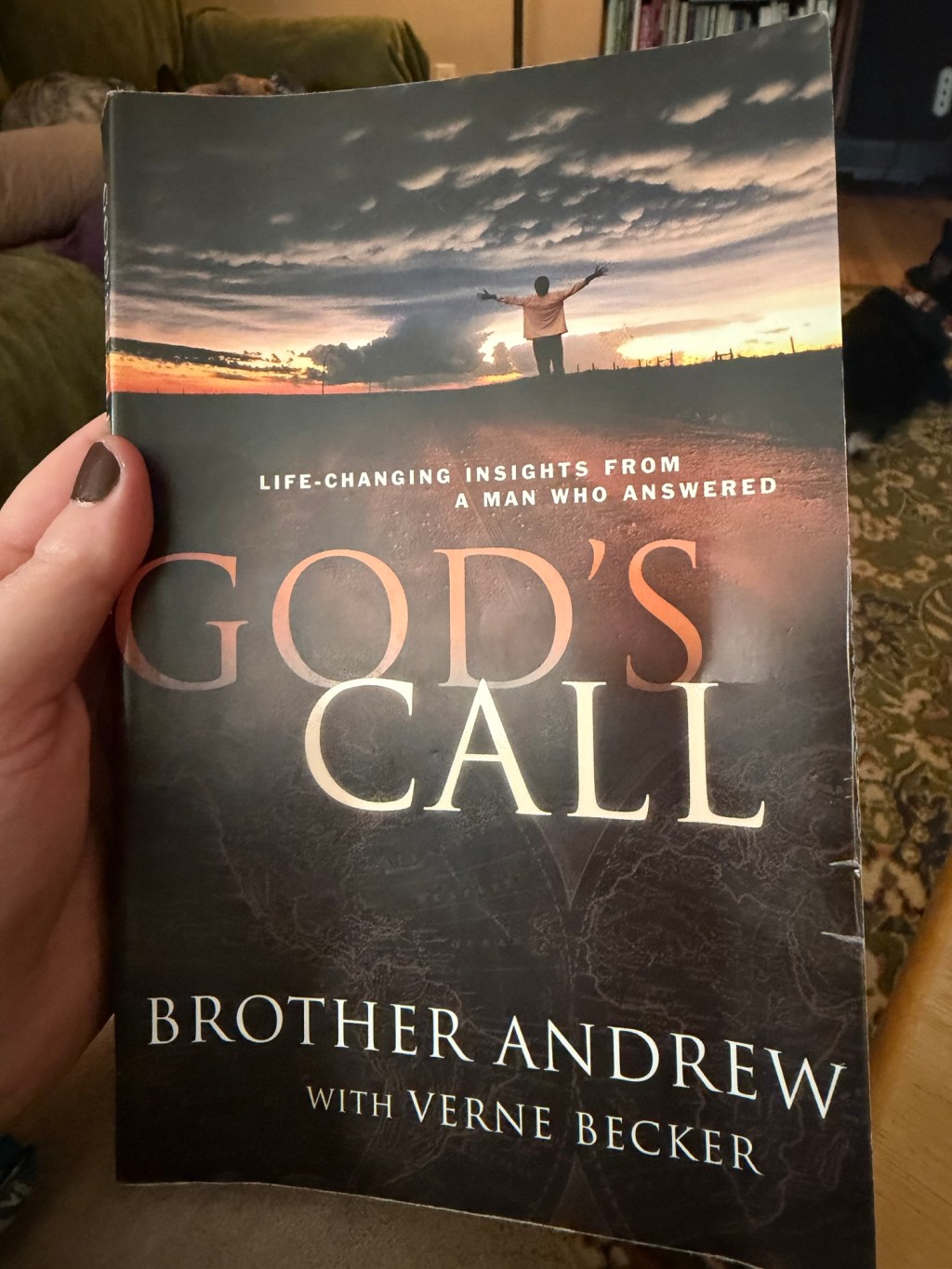
Book 2: God’s Call by Brother Andrew with Verne Becker Re-Published October 1, 2002, Original Publication 1996
Brother Andrew is a Christian from the Netherlands who earned the nickname “God’s Smuggler” for smuggling Bibles to believers behind the Iron Curtain of the Soviet Union. He even wrote a book about that entitled God’s Smuggler. I read that book years ago, and this book, God’s Call, tells the stories of his outreach to other parts of the world where Christians need support. Places like China, Africa, and Muslim nations. He organizes this book into 10 principles for living out one’s calling.
My takeaways from this book:
- A favorite quote: “Finding himself in some of the world’s hot spots, Brother Andrew knows that the Bible is the weapon of choice. Bombs and bullets do not represent the real war. The real war is spiritual, a war for the heart and soul of man. And Andrew urges that ‘the only way to win a spiritual war is with the sword of the Spirit – the Word of God – and with the Word himself, Jesus Christ, the Prince of Peace.’” – Forward of God’s Call by Terry Madison, then President of Open Doors, USA
- This book talks about Brother Andrew visiting churches in Iran – fascinating given the current headlines. It’s also a reminder that there are Christians living in Muslim nations.
- This book reminded me of Christians around the world who are persecuted for their faith. And the so-called ‘persecution’ we experience here in the United States is not the same, and at best should be considered ‘soft persecution’.
- There’s the idea that we can’t love others with the love of Christ if we consider them our enemy. If we consider all Russians or all Iranians terrorists or bad people, we can’t love them with the love of Christ. As a side note, the same applies to immigrants. If we consider them enemies, we cannot love them with the love of Christ.
- There’s the idea that no country is ‘closed’ if you are willing to suffer and die seeking to minister to those in that country. Second-century Latin Theologian and Early Church Father Tertullian wrote that “the blood of the martyrs is the seed of the church,” in Apologeticus.
Book 3: Theocracy: Can Democracy Survive Fundamentalism? Resolving the Conflict Between Fundamentalism and Pluralism by P.J. Tierney Published July 24, 2012
I found this book to be really thoughtfully written. P.J. Tierney grew up Catholic but had a genuine conversion experience, accepting Christ as his Savior. He then served as an Episcopal priest for many years. He is now retired. Given today’s polarization, it was interesting to read his thoughts from 2012, before Donald Trump even announced his candidacy for President. He explores what democracy is, what about democracy necessitates pluralism, and what can happen when religious convictions become fundamentalist beliefs. The term ‘fundamentalist’ isn’t talking about a group or denomination of churches. Rather, in the Christian context, the term refers to the ways in which the firm belief that God has been revealed in the Bible is expressed in Christians’ behavior. While it is true that it is indeed a core Christian belief, about 40 years ago (from 2012, so around 1972), a group of Christians with certain beliefs about what God reveals in the Bible organized to influence politics. This book goes on to explore some of the outcomes or fruits of such political influence. Tierney also highlights fundamentalist thought in both the Catholic and Islamic contexts. He raises the question of whether history itself is entering an era of fundamentalism across several contexts, including Christianity. Along the way, he delves into some Christian and political history. This book made me think, and I appreciate that in someone’s writing.
My takeaways:
- It’s possible we are entering a new chapter of history – the Era of Fundamentalism
- Democracy means rule by the people. So, the people should rightly take an interest in politics – to know the candidates, to do the research. This takes time and effort.
- There have been cases in the past where Christians have sought to influence politics, and it hasn’t always had the best outcome. Think about the Christian crusades.
- There are some weaknesses inherent in Democracy, but there are ways to strengthen it that don’t include violence toward others.
The Iran War
I feel I would be remiss if I didn’t acknowledge the Iran War – or whatever it is being called. When major world events occur, I’m always eager to understand what Christians on the ground are thinking. I will look for articles and or missionary blogs. Here are links to three articles that I found thought-provoking.
- Against Evil or War?: A Defining Choice For Iran’s Christians – March 18, 2026 – Explores how Christians in Iran might be wrestling with how to think about the war as believers.
- What is a Christlike Response to the Iran War – March 11, 2026 – An Australian Christian offers a reflection on what might be most Christlike. Who would Jesus bomb?
- What the Iran War Could do to Your Soul – March 4, 2026 – War is always hell, but we should be looking after our souls to be certain that any instance of war doesn’t make us hellish.
Some of the articles might have a paywall if you are not a subscriber. However, I do think each publication allows a few free articles or a free trial.
Finally, here are Amazon links to the three books I’ve reviewed. I’m receiving no kickback of any kind for reviewing these books or linking to Amazon. Across all three books, the need to look to and focus on Jesus in the Bible and through prayer remains prominent. Jesus is the way, the truth, and the life.
 Hopeful Depths
Leave a comment