
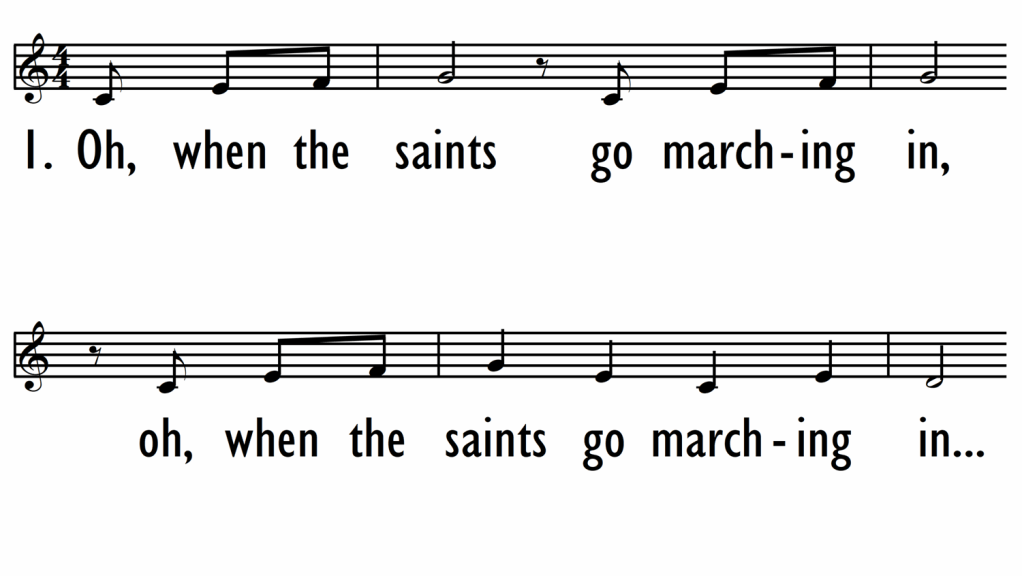
When the Saints Go Marching In—this old-time spiritual captures my heartfelt desire when it comes to my understanding of Christianity. Yet there is so much about American Evangelical Christianity that I dislike and disagree with that, at times, I’m tempted to scream, “I’m not one of those Christians!”
But who are those Christians?
They’re the Christians who support Trump and the agendas of the right-wing politicians currently in positions of power. They’re the evangelical leaders who helped put Trump into power.
I know that the Christian Church has never been perfect. Every generation has had its struggles, its blind spots, and its problems. But I’ve been learning that the very Christianity I grew up with has been much more deeply enmeshed with right-wing politics than I ever realized.
Yes, those Christians call themselves Evangelicals. But I also know a handful of Evangelicals who share my concerns about the agendas being advanced by right-wing politicians. I have other friends who simply don’t want to discuss politics or the controversial policies being enacted today. And I have friends who identify as Evangelicals but have no idea what I mean when I talk about the entanglement I now see between Christianity and right-wing politics.
I used to consider myself an Evangelical, too. But now I find myself wanting to distance myself from the way American Evangelicalism is being expressed here in the United States.
I wasn’t particularly fond of Trump during his first presidency, and I disagreed with many of his policies. But I reasoned that there wasn’t much I could personally do about what was happening in Washington, so I should simply go on living my life. And that’s what I did. I gave very little thought to politics until January 6th happened.
I was stunned by what I saw unfolding on the television before me. At the time, though, I thought the people attacking the Capitol—and I believe that’s exactly what it was, an attack—were fringe individuals. I was deeply disturbed by their claims to be Christians. I simply couldn’t reconcile what I was watching with what I understood to be the core beliefs and behaviors of Christianity.
Since then, my interest in understanding politics has changed. My interest really began to intensify when Elon Musk was put in charge of DOGE and began dismantling so many government agencies at the beginning of Trump’s second presidency. My immediate thought was, “This is a coup. And they’re carrying it out from the inside.”
I remember expressing some of my concerns to a male leader at the church I was attending. His response was a question that went something like this (I’m paraphrasing): “Do you blend politics and faith?”
I didn’t really understand what he meant by that question, and I’m still not entirely sure I do. But that conversation was part of what prompted me to begin seriously studying a theology of politics. I’ve continued learning ever since, and my understanding is still evolving.
I wrote about some of my conclusions here. So far, I’ve limited most of my public comments to the treatment of immigrants by ICE.
Of course I had to say something. My friends have always included immigrants. Even in middle and high school, I had a wonderfully eclectic group of friends. And much of my career, along with some of my volunteer work over the years, has involved working with immigrants.
Through my years of working alongside international students, I’ve known for a long time that many of them are never even invited into an American home for dinner. I’ve always found that troubling. So it confuses me when churches develop ministries to reach international students but remain silent when it comes to speaking out about ICE policies and the treatment of immigrants.
I’ve read the comparisons between much of the American Evangelical Church today and the Lutheran Church in Nazi Germany, whose silence accompanied the implementation of policies against Jewish people. I’ve also read predictions that all of this could eventually lead to another Civil War. I sincerely hope that doesn’t happen, but I can’t dismiss the possibility. We are deeply polarized, and there seems to be very little that genuinely unites us.
For nearly a decade, I’ve also been concerned about the activities of people who identify as Christians while leading or participating in the New Apostolic Reformation.
I spent considerable time studying the New Apostolic Reformation in 2016 and 2017. After doing that research, I concluded that the NAR promotes dangerous doctrines that are not aligned with biblical truth. This movement includes men and women who claim to be apostles on the same level as the apostles Jesus appointed, as well as prophets who claim an authority comparable to that of Old Testament prophets.
And there are people who embrace this movement and currently hold positions of influence in the United States. Paula Cain-White is one such person. She currently leads the White House Faith Office.
In my last post, I mentioned some of the books I’ve been reading and the things I’ve been learning along the way. One of those books was Live, Laugh, Love: The Secret History of White Christian Women and the World They Made by Kristin Kobes du Mez.
After finishing that book, I decided it was time to read an earlier work by the same author: Jesus and John Wayne.
In Jesus and John Wayne, Kobes du Mez traces 75 years of Evangelical Christianity and argues that American Evangelical culture, particularly white Evangelicalism, has been shaped by an ideal of militant masculinity—hence the reference to John Wayne.
From her perspective, Donald Trump’s rise to the presidency isn’t a contradiction of the values white Evangelicalism has promoted. Rather, it’s a fulfillment of them. For nearly a century, certain cultural values have been cultivated and reinforced within white Evangelical circles. Patriarchy is often what lies beneath the language of “family values.” Authoritarianism and Christian nationalism have also been encouraged along the way.
In her book, Kobes du Mez mentions a group known as “The Family,” or “The Fellowship,” which has exerted considerable influence in Washington, D.C. For many years, the organization was led by Doug Coe. However, its roots go back to Abraham Vereide, who founded the organization and helped establish the prayer breakfast movement among political leaders and businessmen.
The Family was formed in opposition to President Franklin D. Roosevelt’s New Deal programs. It is also the organization behind the National Prayer Breakfast. As it turns out, attendance at the National Prayer Breakfast is by invitation only, and numerous foreign leaders are invited from around the world. The gathering’s influence extends well beyond prayer and motivational speaking. Diplomacy also plays a role.
Netflix has a documentary about The Family. Yes, I watched it.
We might never have learned much about this secretive group of fundamentalist elites who claim to be Christians if investigative journalist Jeff Sharlet hadn’t found himself among them. The Family preferred to operate behind the scenes, and its members held a view of themselves as God’s chosen leaders, uniquely positioned to change the world.
To me, this represents yet another distortion of the Gospel message as it is presented in the Bible.
While researching Jeff Sharlet’s book, The Family: The Secret Fundamentalism at the Heart of Political Power, I came across a comment by Frank Schaeffer. If you’re familiar with the history of Evangelical Christianity, you’ll recognize the Schaeffer name. Frank’s parents, Francis and Edith Schaeffer, were practically royalty in evangelical circles. Francis Schaeffer, in particular, was highly influential among young people who came to study at L’Abri in Switzerland. He had a remarkable ability to connect with those who were searching for answers to life’s deeper questions.
Frank Schaeffer had this to say about Sharlet’s work:
“I was once an insider’s insider within fundamentalism. Unequivocally: Sharlet knows what he’s talking about… Those who want to be un-deceived (and wildly entertained) must read this disturbing tour de force.”
That comment piqued my interest. What exactly was Frank Schaeffer talking about?
I’m now about 75% of the way through his memoir, Crazy for God: How I Grew Up As One of the Elect, Helped Found the Religious Right and Lived to Take All (or Almost All) of It Back.
Sadly, it seems that as Frank Schaeffer began questioning the beliefs he had grown up with—and the beliefs his parents had taught him—he discovered that he no longer believed what they believed. But his memoir also documents how he and his parents helped shape what we now know as the Religious Right.
Even his father, Francis Schaeffer, had concerns about the direction American Evangelicals were taking.
We are now approaching the midterm elections in the United States, and I’m concerned about the outcome. Although I struggle with right-wing politics, I also find myself struggling with the agenda of the Democrats at times.
Lee C. Camp’s podcast, No Small Endeavor, has become a favorite of mine. At the moment, I can’t find the exact episode or remember whom Camp was quoting, but the paraphrase goes something like this:
When there are deep divisions, when we have to learn how to get along with people we simply don’t like, there are four options:
- Kill Them — We can simply kill the people we don’t like.
- Coerce Them — We can find ways to force the people we don’t like into doing what we want.
- Flee — We can run away from the people we don’t like.
- Do Politics — We can engage in the hard conversations necessary to determine how to live well with people we don’t like.
And that’s where I find myself.
As I continue to learn, question, and wrestle with what it means to follow Christ amid everything happening in America right now, I find myself hoping that constructive conversation and debate will become possible again in our country, particularly among our politicians.
I don’t want to simply distance myself from those Christians. I want to better understand how we got here, what went wrong, and what it means to remain faithful to the teachings of Jesus.
Because when I think about When the Saints Go Marching In, that’s still the desire of my heart. I want to be among those saints.


Leave a Reply